
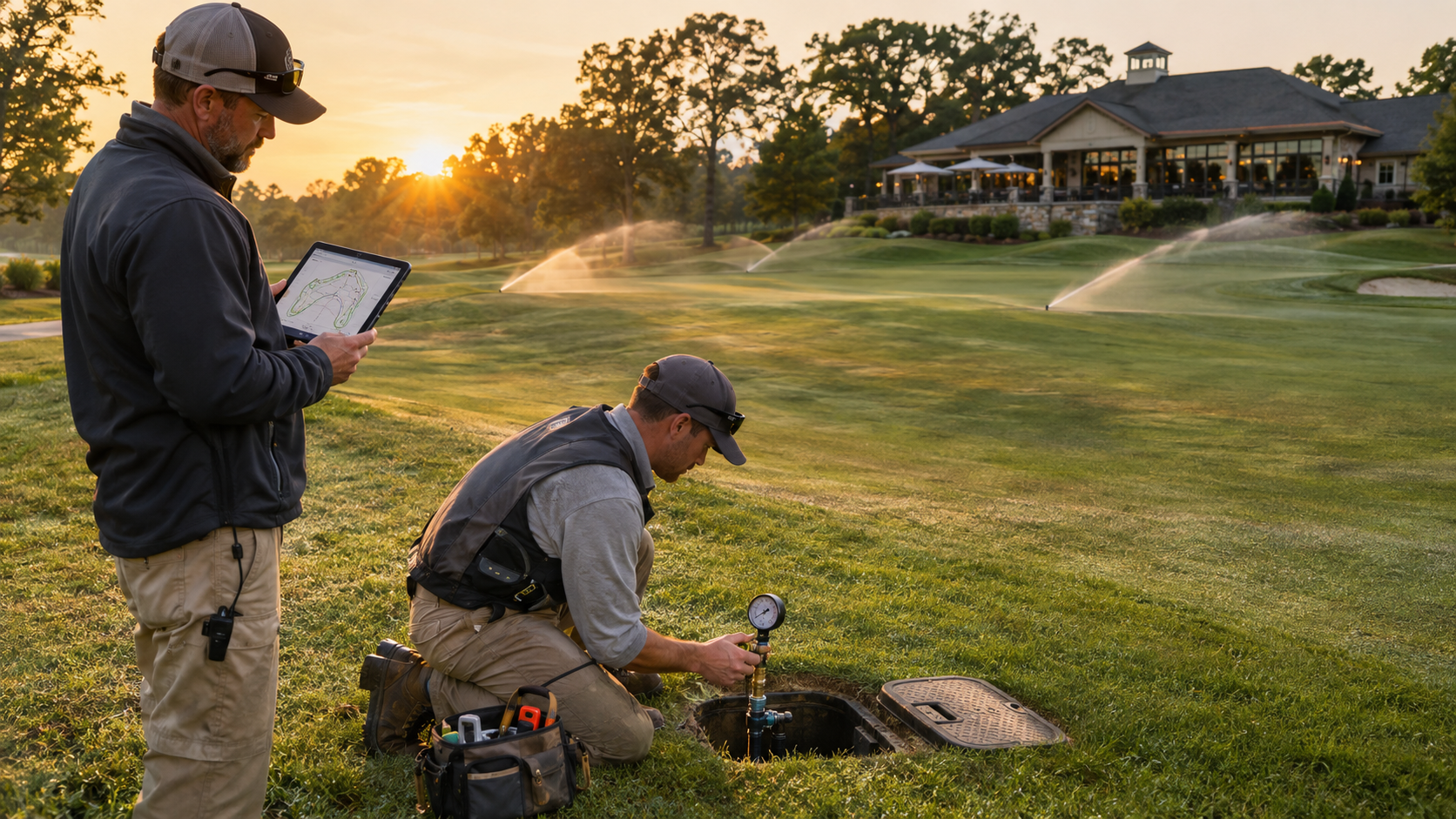
At Los Serranos Golf Club, a 36-hole public facility in Chino Hills, California, USGA-guided testing found irrigation uniformity around 0.60 or less, which classified as poor. After targeted maintenance, auditing, and new hardware, uniformity improved to over 0.80. The facility invested about $25,000 in new hardware instead of jumping straight to an estimated $8 million irrigation overhaul. (Source: USGA, Irrigation Sensation: With USGA Guidance, a California Muni Made Major Water Savings)
That is the kind of example more golf facilities should study. Not because every course has the same irrigation problem. Not because every facility can avoid replacement. But because Los Serranos shows why diagnosis matters before the replacement story hardens.
That idea sits at the center of how we think at Tech2Turf: test capital before you deploy it. The goal is not to delay necessary investment. It is to ensure the facility understands what is failing, what can be improved now, what truly requires replacement, and what the data actually supports.
Irrigation is usually noticed too late. When it is working, most people do not think about it. The course feels playable. Conditions feel consistent. Staff can stay on planned work. Utility costs may not trigger hard questions. The system stays buried, both physically and financially. But when irrigation starts failing, everyone feels it. Dry areas. Wet areas. Emergency repairs. Staff pulled away from planned work. Higher water or electrical bills. Frustrated golfers. Temporary closures. Capital asks that feel sudden because the problem was hidden for too long.
For years, irrigation has often been treated as a back-of-house issue. Something the superintendent understands, the maintenance team fights with, and the golfer only notices when conditions become inconsistent. But that view is too narrow now.
Irrigation affects more than turf. It affects course uptime, water use, electrical cost, labor hours, playability, customer experience, renovation timing, and long-term asset value.
That is why we believe irrigation belongs in the capital conversation earlier. Not after the course has become harder to maintain. Not after the customer experience has already started slipping. Not after the replacement number becomes the only number anyone hears.
Earlier.
The Decision Is Not Simply Repair or Replace
One of the biggest mistakes in irrigation planning is treating the conversation like a binary choice. Patch it again. Or replace everything.
That is usually how the issue feels by the time it reaches ownership, a board, or a city leader. The system has become frustrating. The superintendent has been fighting it for years. Conditions are harder to defend. Repairs are becoming more frequent. The number feels large. The timing feels inconvenient.
But irrigation decisions are rarely that simple. A facility may have a full-system replacement in its future, but that does not mean replacement is the first decision. It also does not mean another year of reactive repairs is the right answer.
The better starting point is diagnosis. Where is the system actually failing? Is the issue pressure, coverage, controls, heads, nozzles, pump performance, design, water source, leaks, scheduling, or maintenance discipline? Which problems are creating the most risk? Which ones are costing the most staff time? Which ones are affecting the golfer experience? Which ones can be improved now, and which ones point to a larger capital event?
Newer irrigation materials and installation methods are also changing how facilities should think about replacement. HDPE pipe systems, for example, use heat-fused joints that can create a continuous pipe system instead of a traditional jointed system. Golf Course Industry has reported that HDPE has become increasingly common in golf irrigation, with more than half of new systems using HDPE mainlines, while industry suppliers note that fused joints can reduce leak risk and water waste when properly designed and installed. (Sources: Golf Course Industry, Too Much of a Good Thing; ISCO Industries, Golf Course Irrigation Pipe)
That does not mean HDPE is automatically the right answer for every facility or every section of pipe. It also does not mean technology removes the need for design discipline. Golf Course Industry has also warned that HDPE systems still need proper pressure ratings, matching fittings, qualified installation, and thoughtful routing. (Source: Golf Course Industry, Too Much of a Good Thing) But it does change the conversation.
The lowest initial cost is not always the lowest total cost. A system that costs less upfront but creates more leaks, more repairs, more labor interruptions, more water loss, more inconsistent conditions, or more repeat disruption may be more expensive than it looks. On the other hand, a higher upfront material or installation cost may be easier to justify when it reduces long-term failure points and gives the facility a more durable platform. That is the kind of tradeoff owners, boards, and municipal leaders need to see clearly.
The question is no longer just whether to keep repairing an old system or approve one massive replacement. The better question is where replacement should happen, what material strategy makes sense, what sections create the most risk, and how the work can be phased without pretending every problem has the same urgency.
Instead of asking, “Can we afford to replace this?”
The better question becomes:
What does the system need us to prove before we commit capital?
That question does not eliminate the need for investment. It improves the quality of the investment. It helps a facility separate emergency noise from real replacement signals, lower-cost wins from long-term exposure, and maintenance frustration from capital readiness.
That is the difference between reacting to irrigation and managing it as part of the capital plan.
Water, Labor, and Guest Experience Are Connected
Irrigation problems rarely stay contained to irrigation. That is why the old way of discussing irrigation is too small.
If the conversation only sounds like, “We have leaks,” or “We need repairs,” or “The superintendent says the system is old,” then the real business impact may never get fully understood. Because the system is not just moving water. It supports the operating promise of the facility.
When irrigation becomes unreliable, water use becomes harder to control. Staff time gets pulled into repairs, hand-watering, troubleshooting, and emergency response. Course conditions become less consistent. Energy costs can rise. Wet areas, dry areas, and temporary disruptions start to shape how golfers experience the property. The maintenance team may still be doing excellent work, but they are doing it with a system that creates drag every week. That drag has a cost.
USGA’s Water Conservation Playbook is built around practical water-saving strategies, implementation costs, and facility-level tradeoffs. The broader point is that water planning is not only about conservation. It is about matching the facility’s resources, infrastructure, maintenance practices, and course expectations to a more reliable operating model. (Source: USGA, Water Conservation Playbook) Labor makes this even more important.
Golf Course Industry has reported that labor commonly represents 50% to 70% of annual maintenance operating budgets. When that much of the maintenance budget is tied to people, staff time lost to irrigation issues cannot be treated as background noise. It is operating capacity being consumed by the system. (Source: Golf Course Industry, Rising Cost of Golf Course Maintenance) And in a labor market where reliable maintenance help is not getting easier to find, those lost hours matter even more. That is the part many boards, owners, and municipal leaders may not see clearly enough.
An irrigation issue does not only create the cost of a repair. It can pull a superintendent, assistant, irrigation tech, mechanic, or crew member away from planned work. It can turn a morning maintenance schedule into a reaction plan. It can delay mowing, bunker work, detail work, cultural practices, project work, or course setup. It can force hand-watering that may be necessary, but still consumes labor that could have been used elsewhere. And over time, that creates a hidden choice. Either the team absorbs the extra work, and something else gets less attention, or the facility pays for more labor, more overtime, more outsourcing, or more condition inconsistency than it expected.
That is why irrigation problems can look like staffing problems. A facility may think it needs more people when part of the issue is that its infrastructure is forcing the people it already has into the wrong work. That should change how owners, boards, and municipal leaders hear the irrigation conversation. A leak is not just a leak. A dry spot is not just a dry spot. A temporary closure is not just a temporary closure. Those are operating signals.
They may point to water waste, labor drag, condition inconsistency, customer frustration, deferred capital, or all of the above. And if they are treated as separate problems, the facility can underestimate how much the irrigation system is really costing.
The better conversation connects them.
What is the system costing in water?
What is it costing in staff time?
What is it costing in consistency?
What is it costing in guest trust?
What is it costing in future capital flexibility?
That is when irrigation stops being a maintenance complaint and becomes an owner-level decision.
Irrigation Belongs in Capital Readiness
Once irrigation is understood as water, labor, uptime, guest experience, and future flexibility, it becomes hard to leave it buried inside the maintenance conversation. It belongs in capital readiness.
That matters for existing owners and boards, but it also matters for buyers, lenders, municipal leaders, and anyone underwriting the future of a golf facility. A healthy tee sheet can hide irrigation exposure. So can a good year of weather. So can a strong superintendent who has been quietly holding the system together with repairs, workarounds, staff knowledge, and careful timing.
But those are not the same as infrastructure health. If a facility is planning a major renovation, acquiring a course, asking a city for capital, preparing a board request, or evaluating long-term viability, irrigation should be part of the front-end review. Not because every issue requires immediate replacement, but because hidden irrigation risk can change the real economics of the plan. That is where we think many facilities need better visibility.
What looks like a manageable capital plan can change quickly if the irrigation system is older, poorly mapped, leaking, undersized, inconsistently pressurized, or dependent on components that are becoming harder to maintain. A buyer may underwrite upside without fully seeing the buried capital exposure. A city may approve visible upgrades while the system underneath still limits reliability. A club may invest in member-facing improvements while the course infrastructure quietly becomes a constraint. That is why irrigation diligence matters.
It does not have to make every decision slower. It should make every decision clearer.
The goal is to understand the risk early enough that leadership still has options: targeted repair, sectional replacement, controller upgrades, pump work, mapping, better scheduling, system audit, or a planned full replacement when the evidence supports it.
That is capital readiness. Not panic. Not delay. Not guessing.
Knowing what the system is telling you before the next major decision depends on it.
Irrigation Is Not Exciting Until It Becomes Embarrassing
Nobody posts a ribbon-cutting photo for pressure regulation.
Most golfers do not thank the facility because the pump station worked, the heads matched the coverage plan, or the driest corner of the fairway finally held moisture evenly. That is the challenge with irrigation.
When it is doing its job, it disappears. But when it fails, it becomes one of the most visible problems on the property. It shows up in the brown edge that everyone drives past. It shows up in the soft landing area that never firms up. It shows up in the closed hole, the washed-out section, the inconsistent green surround, the cart-path-only day, the superintendent explaining conditions again, and the golfer wondering why the course feels worse than the rate suggests.
That is why irrigation must be understood before it becomes a reputation problem. A facility can market a better experience, invest in amenities, improve booking, add technology, and build new programming. But if the course itself becomes inconsistent, unreliable, or harder to keep open, the rest of the story gets weaker. This is not about chasing perfect conditions.
Most facilities do not need to be perfect. They need to be reliable. They need playable. They need predictable enough that the staff can plan, the golfer can trust the experience, and leadership can make decisions without getting surprised by the same buried problem every season. That is the point.
Irrigation does not have to be glamorous to be strategic. It just has to be understood before it gets loud.
What Comes Next
Irrigation is not just a turf problem. It is a capital planning problem. It is a labor problem. It is a guest experience problem. It is a water stewardship problem. And in many cases, it is a decision-confidence problem. That does not mean every facility needs to rush into a full replacement. It means every facility needs to understand what the system is telling them before the next capital decision depends on it.
That is why this conversation belongs with owners, boards, municipalities, investors, and operators, not only the maintenance team.
At Tech2Turf, this is where we believe we can be useful: helping facilities turn hidden infrastructure questions into clearer capital conversations before the only options feel like another patch or a rushed replacement.
That is the broader lesson of this part of Golf’s Reinvestment Era.